Freedom with consequences and the Trees of Life
By Anton
In most life simulators, your character doesn’t matter all that much. You pick a name, click your way through the years, and the game rolls along the same rails whoever you are. We felt the genre was lacking in content, variety and direction, and we wanted to fix that.
So we set ourselves a simple-sounding goal. Freedom, but with logic. You can do almost anything, but your decisions should make sense given everything you did before. Choices build on each other, so no two playthroughs end up the same.
The Trees of Life
Before anything had been written or designed, we already knew the game would have Trees of Life. We wanted events with flavour instead of generic ones, without ever becoming repetitive. That meant roughly ten times the workload, and a structure to hold it all together. Thus the Tree of Life was born.
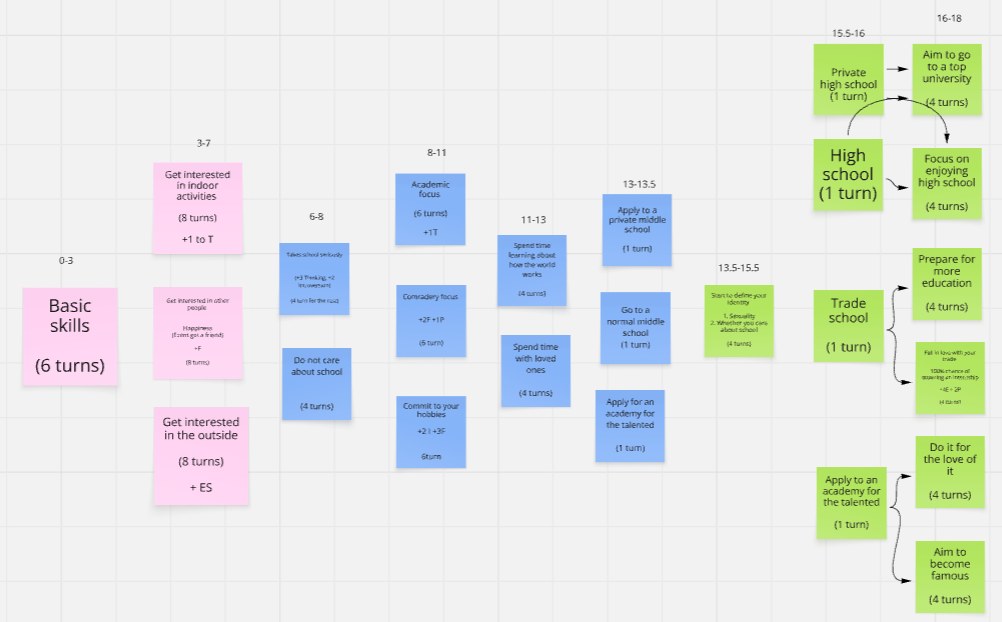
The first one we designed covered the first 18 years of a player’s life, and boy, was it long. Looking at it now, we were clearly full of naive energy, thinking we’d finish the whole project in half a year. Even so, its sticky notes already held dozens of ideas. There were unlockable activities, attribute boosts, skills and hobbies, in-event minigames, clubs, friends, personality development, turning-point events and, at the end, four event-heavy post-18 life paths to build the rest of the game around.
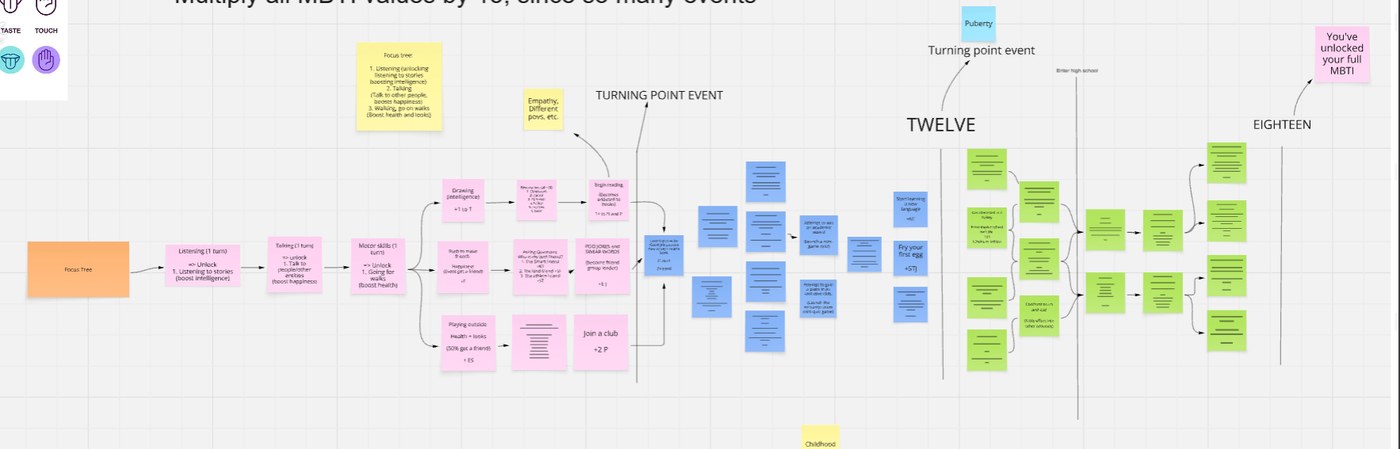
There was one problem. Nobody wants to stare at a giant tree when they could be playing the game we had in mind. So the tree had to shrink. We squeezed events and ideas into fewer but “higher-calorie” events and choices. This is the version closest to the final game, except that the tree is now vertical.
We made a similar call about the interface. In the earliest versions, every decision was laid out as text in a running log, like in the paper prototype from our welcome post. After a couple of months we realised players would be reading far too much, and that it was boring. So we took on more work instead, with backgrounds and special effects that react to the player’s environment and past choices, so the world feels active and reactive. Our graphics developer tells that story in The story of ReliveIt’s backgrounds.
Who you are
A tree gives you choices. Personality makes sure those choices come from someone. Once the first tree was done, we wanted every childhood to feel unique, even when two players walk the same path, and every decision to carry weight. The answer was a personality that develops over the first 18 years.
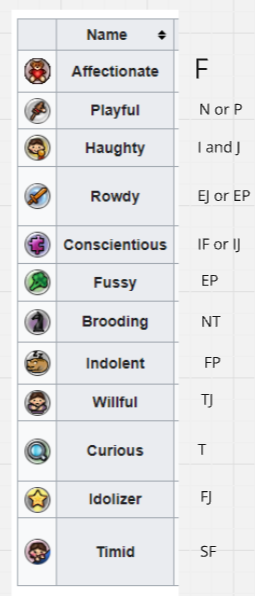
For the framework we chose the sixteen MBTI types, for their simplicity and popularity. Taking inspiration from the strategy game Crusader Kings II, we mapped general behavioural traits onto specific MBTI preferences. A Playful character leans N or P, for example, while a Haughty one is both I and J.
Personality traits are built into each decision of each event. The goal is for players to feel like a unique reflection of every choice they made on the way to turning 18. Through rigorous testing, we made sure every personality type is fully achievable.
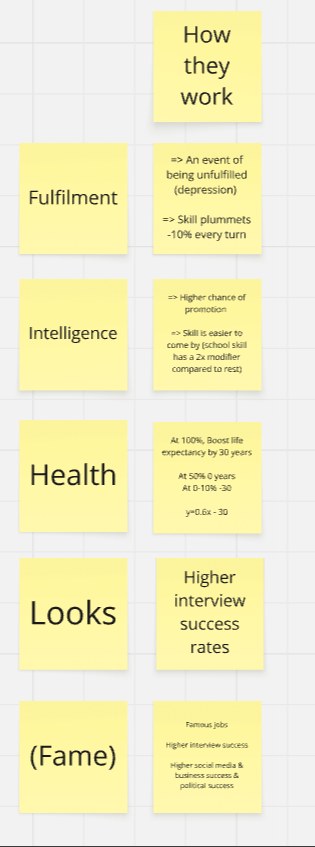
Alongside personality we gave the player a handful of core attributes, each with a real effect on the game. At first we believed in complex effects, but once we saw different outcomes snowballing for minor rewards, we simplified. That effort is better spent on major decisions and stories for the player to discover.
The set stayed with us from the beginning to the end of development, with two changes. We added stress mechanics, and we renamed fulfilment to happiness.
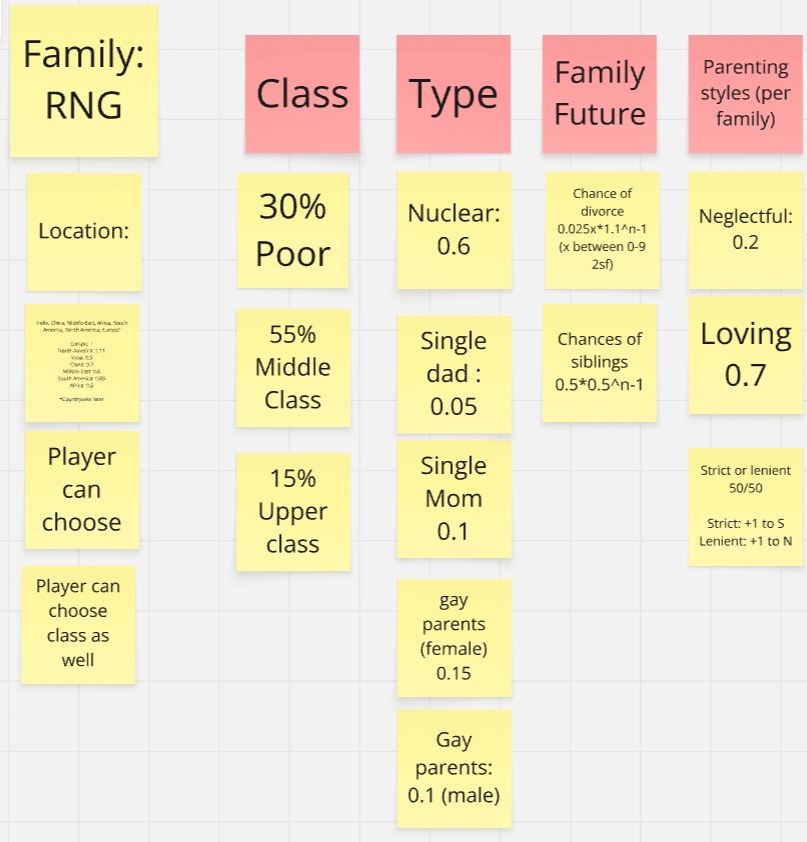
Your background matters too. We had just graduated high school and, a little embarrassingly, tried to apply our fresh knowledge to the game by modelling families with mathematical formulas. Sometimes it worked, sometimes it didn’t, and the end result is a hybrid of our original vision, much better than we intended.
A player’s background became a series of weighted dice rolls covering social class (30% poor, 55% middle class, 15% upper class), family type, the chance of divorce or siblings, and a parenting style that nudges the child’s personality. No two childhoods begin the same way.
Giving every tree a shape
We planned many Trees of Life, covering all the paths a life can take, from military service to a university career in academia. But scope isn’t infinite, so we kept only the most interesting ones.
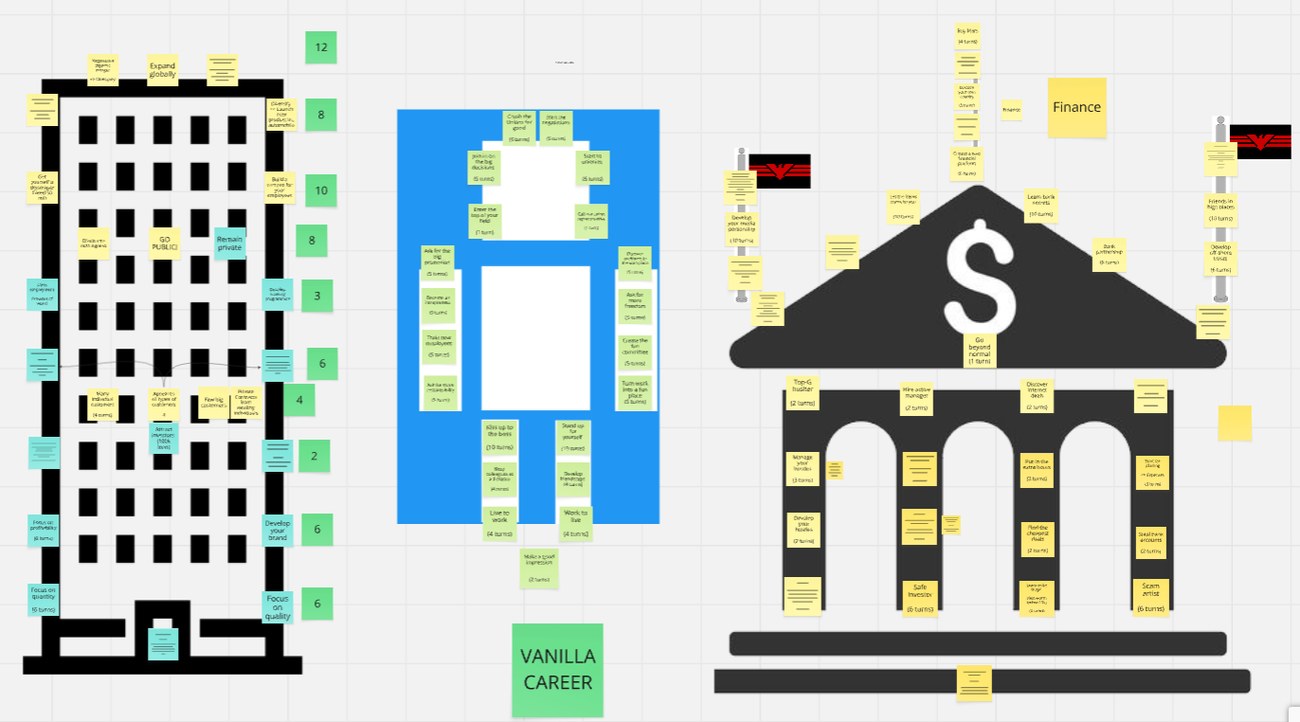
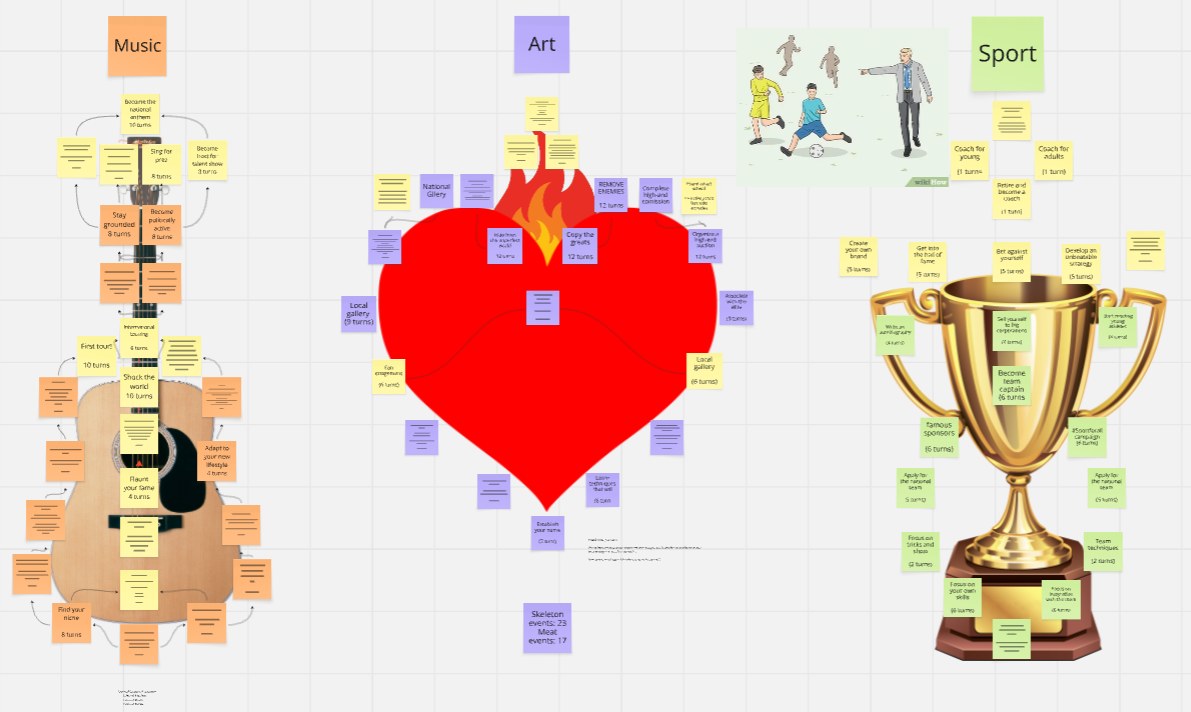
For each tree we wanted a theme tied to an object or symbol. We imagined the theme first, then the image, and only then laid the tree out on top of it, so that every tree feels unique and reflects its own soul.
The business tree is shaped like a skyscraper, the vanilla career tree like an average person, and the finance tree like a bank.
The music tree is a guitar, the art tree a burning heart of passion, and the sports tree a trophy.
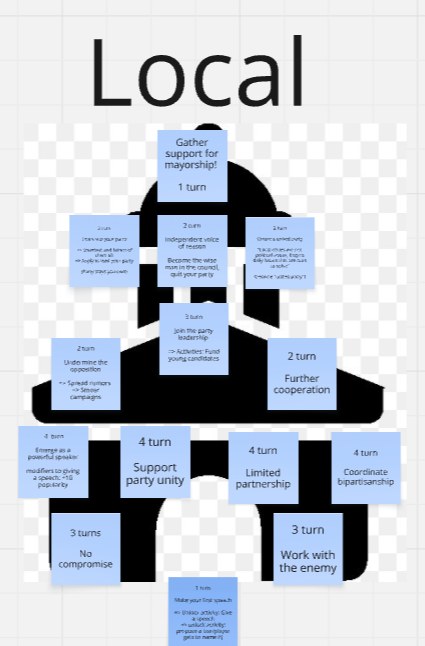
Politics is structured on different political buildings and objects, such as the mayor’s office, where the local path begins.
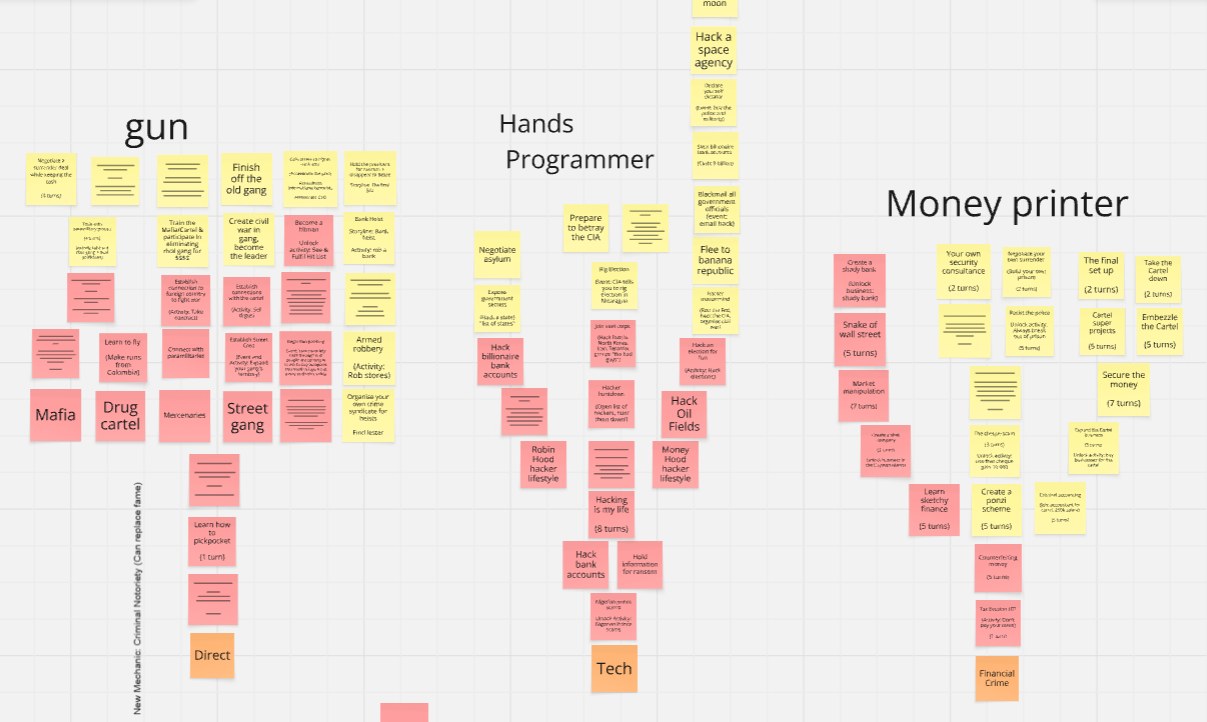
Some trees defy conventional objects altogether. The crime tree has three paths, each with its own symbol, a fictional gun, a money printer and a hacker’s hand.
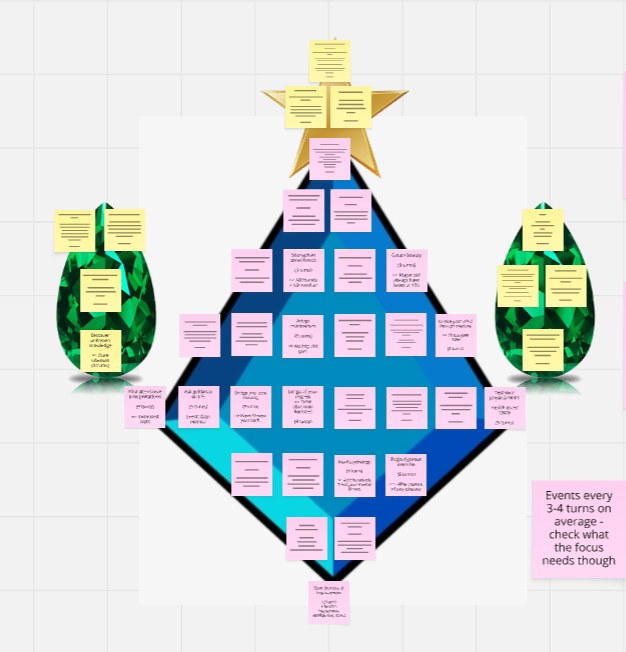
For wellbeing, we imagined a beautiful gemstone. After finishing the path, the player’s life itself, by tending to its own needs, becomes the jewel (metaphorically).
What our first project taught us
- Start on paper. A sketch will tell you whether an idea works long before a tool does.
- If you want a lot of unique content, you need a structure for it first.
- Be ready to shrink your own ideas. Fewer, richer events beat many thin ones.
- Show, don’t tell. Players would rather see their choices than read about them.
- Scope is finite. Keep the most interesting ideas and let the rest go.
- Our wonderful main coder will have a helluva lot of work ahead of him.
- You will never be able to predict how quickly or how slowly something will take. Some seemingly large things can take a couple of minutes, while small things may take years. You will only have best guesses.